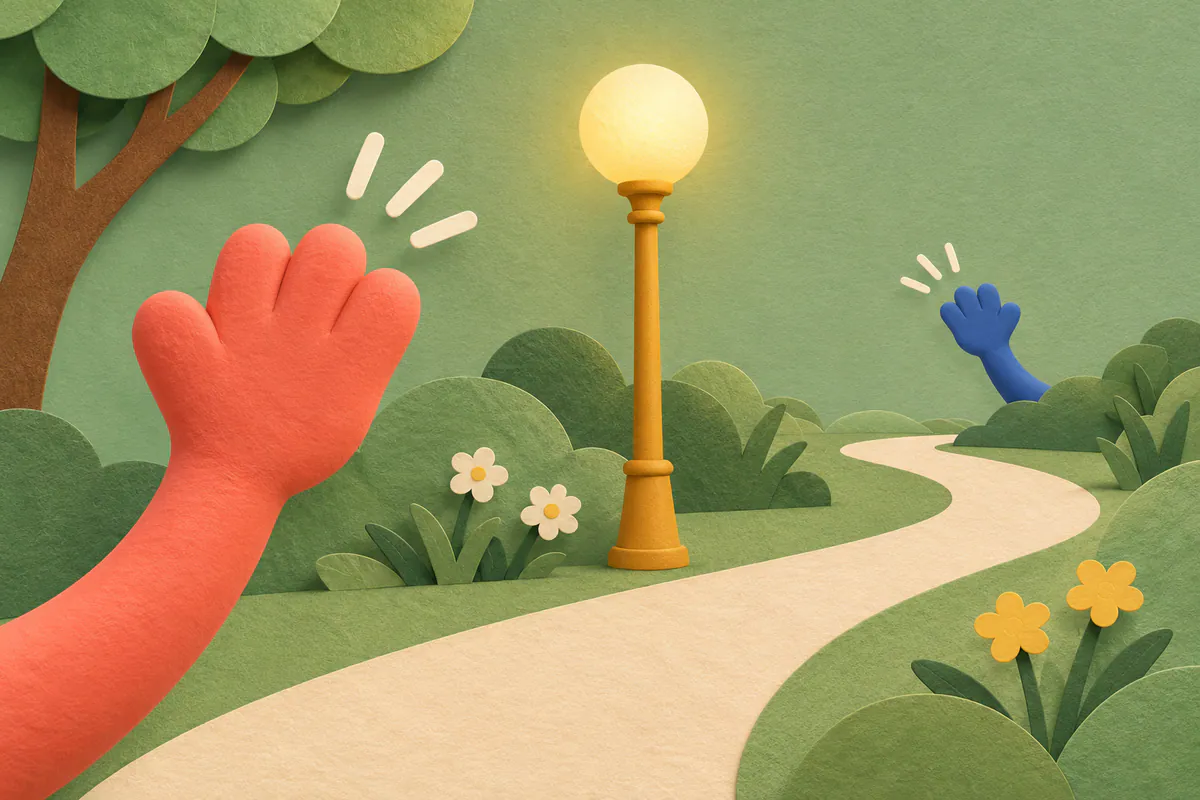
You see someone across the street, lift your hand, and smile. They look puzzled. A moment later you realize they are not the friend you thought you recognized. Your hand is still in the air, and now you would quite like to disappear behind the nearest tree.
An awkward greeting can feel surprisingly large while it is happening. You do not have to persuade yourself that it felt wonderful. You can acknowledge the mix-up, finish the exchange, and continue with the day. A mistaken wave is a small social error, not a complete description of you.
Give the moment a simple explanation
If the person is close enough to hear, try: "Sorry, I thought you were someone I knew." That supplies the missing context without asking them to reassure you. A small smile is optional; you do not have to turn the incident into a performance.
If they are across a busy street or already walking away, you can lower your hand and move on. There is no need to chase a stranger to explain a harmless gesture. Match the response to the actual situation rather than to how embarrassed you feel.
You might be tempted to pretend you were waving to someone behind them. That can prolong the moment, especially if you start searching for an imaginary person. A plain correction usually gives you a clearer place to stop.
Separate what happened from what you imagined
The observable facts might be: you waved, the other person looked uncertain, and you realized the mistake. "They think I am ridiculous" is an interpretation. You cannot know that from a puzzled expression.
Try a description that stays close to the evidence: "I recognized the coat before I looked properly at the face." Or simply: "I got the person wrong." Neither sentence denies the embarrassment. Both avoid turning a brief mix-up into a judgment about your intelligence or social ability.
You also do not need to insist that the stranger instantly forgot. Perhaps they did, perhaps they did not. Your next step does not depend on proving what is happening in someone else's mind.
Let your body catch up with the correction
You may still feel warm in the face after the practical problem is over. Give yourself a moment without requiring the feeling to vanish before you continue. Lower your shoulders if they are raised, notice where you are standing, and return your attention to the route ahead.
If you are crossing a road, watching traffic comes before composing a perfect apology. If you are in a queue, return to the queue. A concrete next action can keep the incident from becoming the only thing you attend to.
This is not a test of how quickly you can become calm. You can feel awkward and still buy your bread, catch your bus, or meet the person you were originally looking for.
If someone with you laughs
A companion might find the mix-up funny without intending to embarrass you. You can join in if you genuinely find it funny too: "Same coat, completely different person." You do not owe anyone a joke, though.
If repeated teasing becomes uncomfortable, say what you want: "Yes, I mixed them up. Let's leave it there." If necessary, repeat that request privately. The stranger's puzzled look and your companion's response are separate things; you can deal with each without making the original wave into a larger failure.
Avoid adding insults about yourself just to keep the mood light. You can acknowledge an error without announcing that you are hopeless.
Do not make the next greeting a punishment
After an awkward wave, you might decide never to greet anyone first again. Before adopting that rule, ask whether it fits the scale of the event. One mistaken recognition does not require withdrawing from every friendly encounter.
Next time, you could look for a second identifying detail before waving or use a smaller greeting until the person responds. These are ordinary adjustments. You do not need an elaborate checking ritual or certainty about every face you pass.
The NHS guidance on self-esteem suggests treating yourself with the kindness you would offer a friend when you become self-critical. In this situation, imagine a friend telling you the same story. A proportionate response is likely to be much gentler than the speech you are giving yourself.
Close the story without rewriting it
If you catch yourself replaying the wave later, try one factual ending: "I mistook a stranger for my friend, corrected it, and carried on." You do not have to review every angle of their expression to earn permission to stop thinking about it.
For another ordinary mix-up, read when you arrive on the wrong day. Our guide to asking to close an open window offers wording for a small request when speaking up feels awkward.
You can use TherapyWithAI to rehearse a fictional exchange: "Help me practice a brief correction after greeting the wrong person. Do not guess what the stranger thought." Leave out identifying details. AI can help with wording and reflection; it cannot read minds or replace professional mental health care.
If worries about everyday interactions repeatedly interfere with activities you want to do, consider speaking with a qualified professional. For this moment, a short correction is enough. Your hand can come down, and the day can continue.