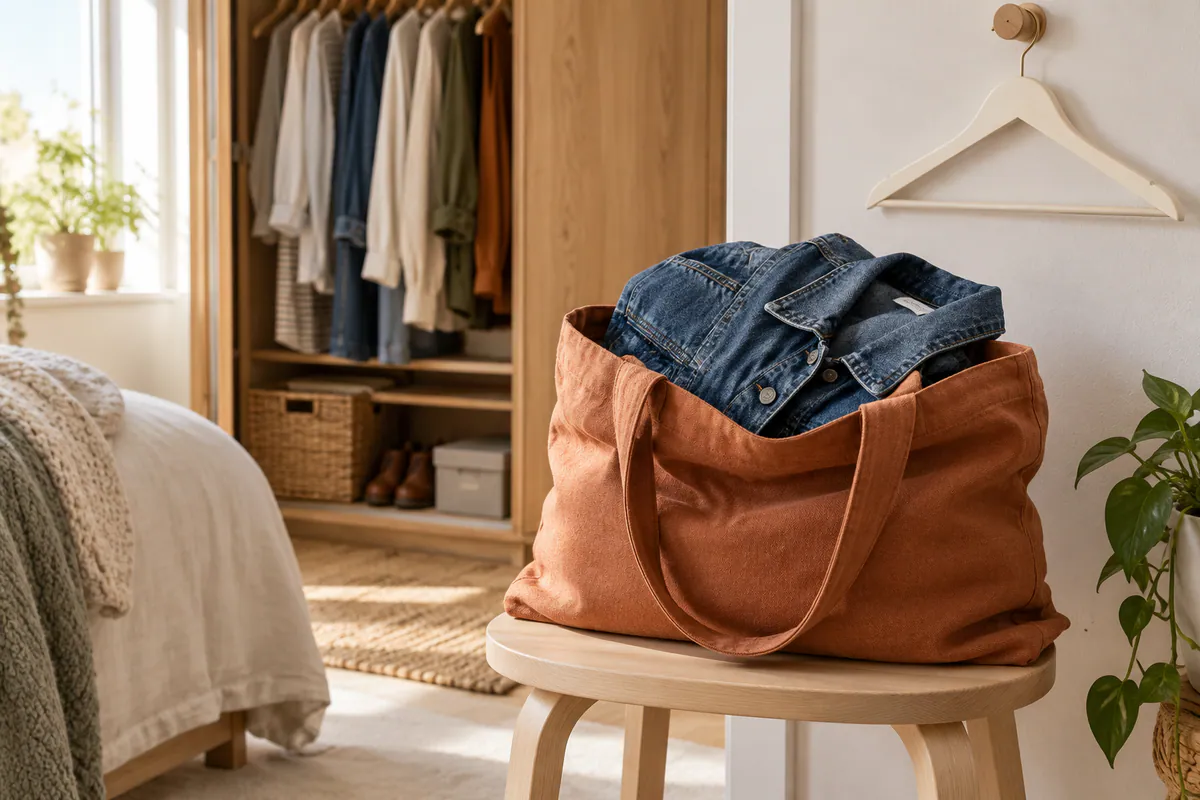
You reach for a jacket you have not worn in years, and suddenly you are deciding more than what belongs in a wardrobe. It was your first-job jacket, your regular concert outfit, or something you wore when your days looked different. Giving it away can feel like giving up a version of yourself.
You do not need to empty the wardrobe or prove that you have moved on. A smaller task is enough: decide what this one item means, whether it still has a use, and what you want to keep of its story. Keeping it is an option. So is letting it go without declaring that the past no longer matters.
Separate the garment from the chapter
Try naming the attachment in a plain sentence: “This reminds me of feeling independent,” or “I bought this for a job I was proud to get.” That is more specific than “I cannot get rid of it.” It gives you something to consider besides the hanger and the available space.
Then ask whether the garment is the only way you can retain that connection. You might already have a photograph, a friendship, a skill, or a story from the same period. An object can carry meaning without being the sole container for it. You can value the chapter even if this particular piece no longer belongs in your everyday wardrobe.
If the memory is difficult rather than pleasant, you do not have to revisit it in detail to make a practical decision. Put the item aside and choose something less emotionally demanding, or stop for today.
Check the rule hiding inside the guilt
Listen for a sentence that turns a choice into an obligation: “If I donate it, the money was wasted,” “Keeping it proves that time mattered,” or “I should still be the person who wears this.” Write down the sentence before treating it as a fact.
The NHS guidance on reframing unhelpful thoughts suggests examining the evidence and considering other ways to see a situation. Applied here, a more balanced thought might be: “I used this jacket during an important time. I can appreciate that use without keeping it forever.” This is a possible perspective, not a requirement to feel cheerful about the decision.
If the item was a present, when a gift is not your taste explores the separate question of gratitude and preference. Appreciation for a giver does not need to settle every future storage decision.
Make room for practical reasons to keep it
Sentiment is not the only reason an unworn item might stay. Replacing it could be expensive, it may suit an occasional event, or you may need it in another season. Consider your actual circumstances before applying a sweeping rule about anything unworn for a year.
Ask three concrete questions: Is it comfortable and usable now? Is there a realistic occasion for it? Can I store it without crowding out things I need? You do not have to try it on if that would make the task harder. Size labels are information about a garment, not a judgment about your body or your worth.
A clear reason to keep something can end the debate. Put it where you can find it and stop making yourself decide again every time you open the door.
Choose a small way to preserve the story
For an item you no longer want to wear, consider taking one photograph and writing a sentence about its significance. For example: “I wore this blue jacket on my first independent trip.” The photograph is optional; you do not need to turn a simple sorting task into a documentation project.
You could also keep one representative garment from a period instead of every piece connected to it. Or you might choose a small memory box outside your daily clothing space. Decide what fits your home and preferences. Neither minimalism nor a full wardrobe is evidence that you have handled your feelings correctly.
If you are uncertain, place the item in a separate bag with a date to reconsider it. That date is a reminder to review, not a promise to discard. Avoid mixing undecided belongings with donations that someone else may take away.
Finish one decision, including its destination
Imagine you have three old work shirts. One remains useful for interviews, one carries a particular memory, and one is uncomfortable and rarely comes to mind. You keep the first, photograph the second before deciding, and set the third aside for donation if it meets the recipient's requirements. There is no need for all three decisions to match.
Before donating, check what the local organization accepts and whether clothing needs to be clean or in a particular condition. If an item is unsuitable, look up the actual local textile options. Do not assume every collection point can reuse every garment. Remove personal items from pockets and make sure the clothes are yours to give away.
End before the task becomes a verdict
One completed decision can be enough for today. Return the other clothes to a usable place and notice what remains unresolved without demanding an immediate answer. Feeling sad after a choice does not automatically mean it was wrong; it may simply mean the object mattered to you.
You can use TherapyWithAI to put the competing reasons into words or rehearse a kinder sentence about the choice, using fictional details. AI support cannot replace professional care. If distress around possessions persistently interferes with daily life or makes parts of your home difficult to use, consider speaking with a qualified mental health professional.
The practical aim is a wardrobe that serves your life now, with room for the memories you deliberately choose to keep. You can make that choice one garment at a time.