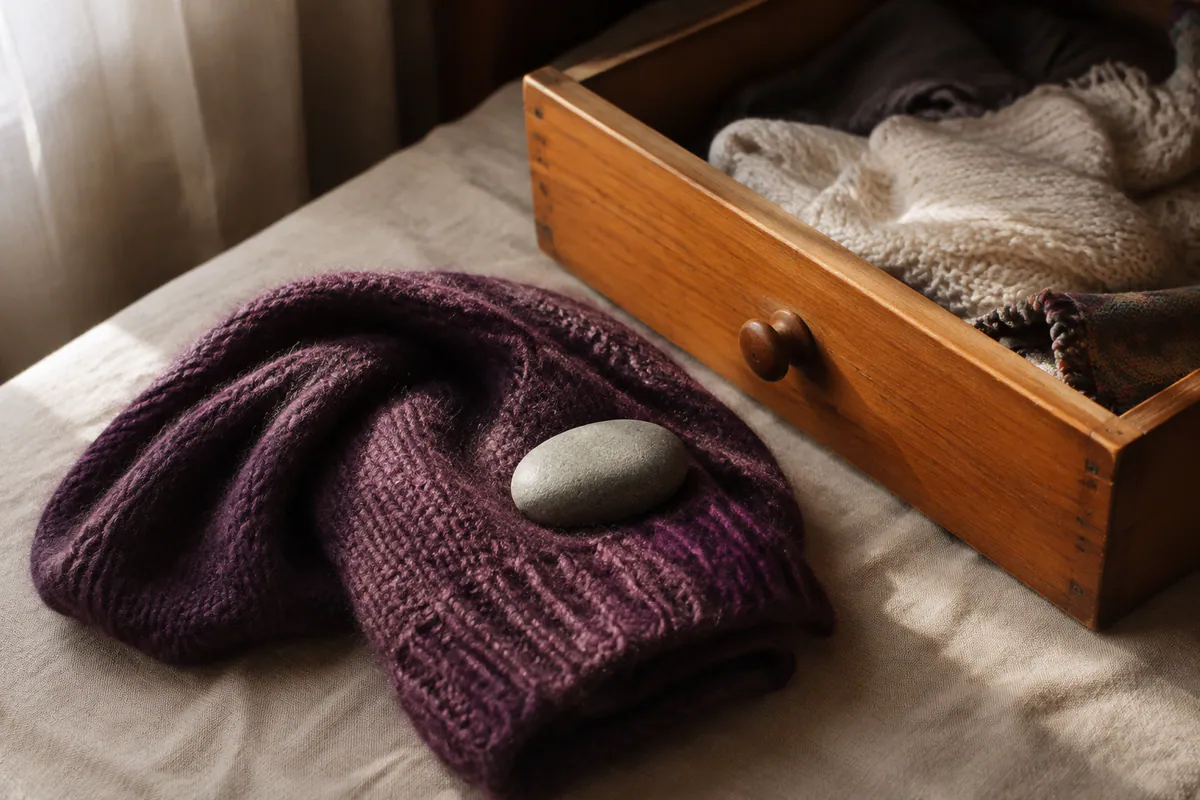
A drawer can look like a small household task until you open it after someone has died. A familiar scarf, a receipt, or an ordinary mug may bring up more than you expected. You may want the room cleared and also want every object to stay exactly where it is.
You do not have to make every decision in one sitting. When circumstances allow, a temporary place for undecided items can separate the practical work of sorting from the pressure to reach a final answer. This is an optional way to organize a difficult task, not a grief exercise you must complete.
The NHS guidance on grief explains that people respond differently to loss and suggests manageable targets rather than trying to do everything at once. The suggestions below apply that modest principle to belongings; they are not a clinical treatment or a timetable for grieving.
First, find out what actually needs deciding today
There may be a real deadline: a room needs to be handed back, someone needs space, or storage costs are becoming difficult. Name the practical requirement precisely. “The wardrobe must be empty by Friday” does not necessarily mean “Every item must have a permanent destination by Friday.” Temporary storage may be an option if it is affordable and agreed.
Check with the person responsible for handling the belongings before moving, donating, or giving anything away. Set aside paperwork, valuables, and items whose ownership is unclear for the appropriate person to review. This article concerns the emotional task of sorting, not decisions about an estate or who is entitled to an object.
If there is no immediate deadline, choose a starting point that feels tolerable. That might be a shelf of everyday objects rather than a box of personal letters. You can also decide that today is only for gathering bags and arranging help.
Give uncertainty a physical place
Use a box, a shelf, or a clearly marked bag for items you are not ready to decide about. It need not be beautiful. Its purpose is to prevent each uncertain object from stopping the whole task or being sent away under pressure.
For example, you might know that several kitchen duplicates can go to an agreed recipient, but feel unsure about one chipped cup. Put the cup in the undecided space and continue only if you want to. You have made a decision about today: the cup is staying for now.
If space is limited, choose the container size together with anyone sharing the room. That is a practical constraint, not a measure of how much you loved the person. A photograph or a brief written memory is another possibility for some objects, but it does not have to replace keeping an item that matters to you.
Ask for a helper with a specific role
Support is easier to use when the job is clear. Try: “Could you sit with me while I sort this drawer? Please ask before putting anything in a donation bag.” Or: “I want help carrying boxes, but I want to choose what goes inside them myself.”
A helper can read labels, bring water, make a list, or take agreed items to their destination. They do not need to persuade you to let go. If they start making decisions too quickly, you can pause: “I need us to slow down. Nothing leaves this room until we have checked it together.”
Different relatives may attach meaning to different objects. Before disposing of shared family belongings, agree on how people can express interest. If a disagreement becomes painful, set the disputed item aside where possible and return to a less charged task. Sorting day does not have to resolve the whole family's grief.
Choose a stopping point before you begin
Try one drawer, a few objects, or a short period that fits your energy. Leave enough time to close containers and put the room back into a usable state. You can stop sooner if the task becomes too much.
An ending can be ordinary: put the undecided box somewhere safe, note what remains, and make something to eat. You do not need to end with a sense of closure. You may feel sad, relieved, irritated, numb, or several things together. None of those feelings tells you whether you sorted correctly.
If someone is helping, agree on what happens next before they leave. “The two sealed bags can go tomorrow; the open box stays here” is clearer than assuming everyone remembers which pile meant what.
Revisit choices without turning them into a test
You can put a gentle reminder in your calendar to consider the undecided box again, if that would help. The reminder is an invitation to review it, not a deadline to feel differently. At that point, you may keep everything, choose one destination, or decide you need support with the task.
For more resources, explore our emotional-support articles. If grief is making daily life difficult or your own efforts are not helping, speak with a qualified professional, primary-care clinician, or bereavement support service. You can ask for help before you have finished sorting anything.
You can use TherapyWithAI to draft a request for practical help or reflect on what makes a particular decision difficult. Avoid sharing private letters or identifying details unnecessarily. AI cannot decide what an object means to you, replace professional care, or provide emergency help. If you are in immediate danger, contact local emergency services.
For today, a useful outcome might be one cleared shelf and one closed box marked “undecided.” Making space for uncertainty can be part of the practical plan.