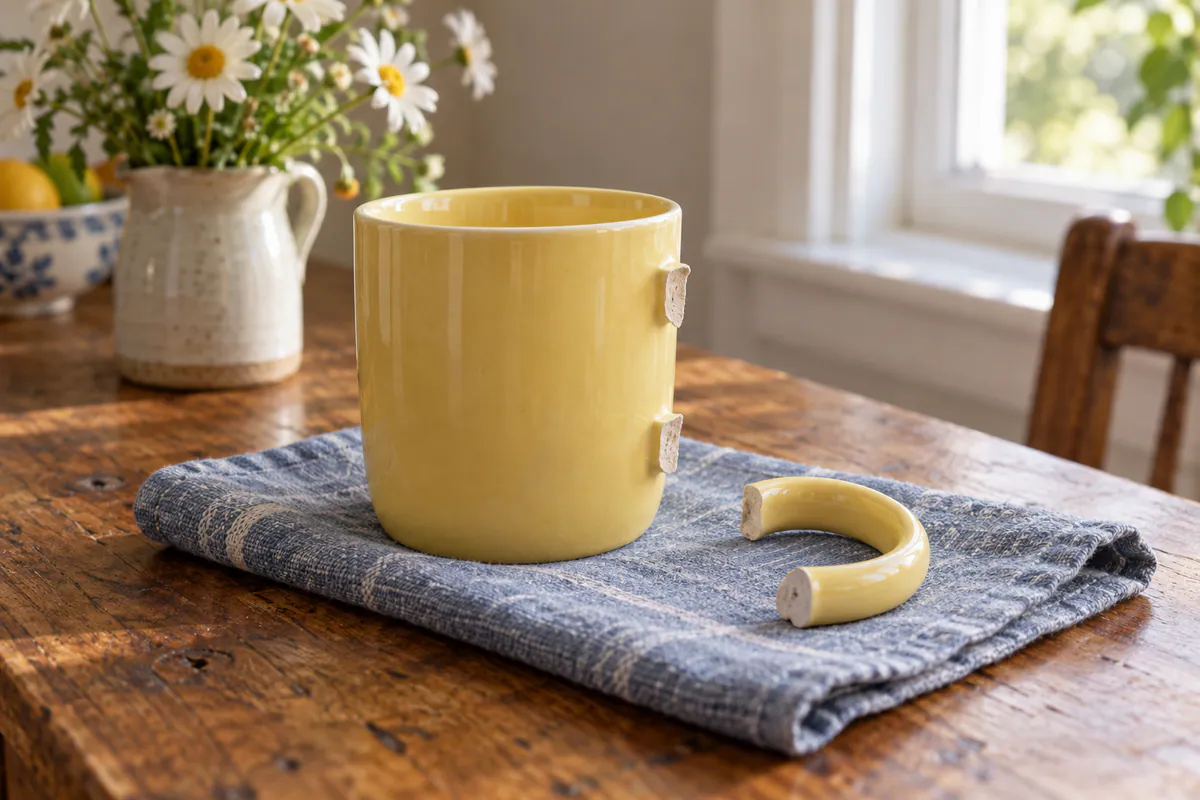
A favourite mug slips from your hand. The handle breaks, and the sadness feels out of proportion to the object on the floor. Perhaps it came from someone you love, travelled with you through several homes, or belonged to an ordinary morning routine you did not realise you valued. Replacing the mug would not replace those associations.
You can take that feeling seriously without deciding immediately what to do with the object. First deal with the practical situation safely. Then give yourself room to decide whether you want a keepsake, a repair assessment, a photograph, or simply a moment to acknowledge what the mug meant. There is no single correct way to care about a possession.
Name what you lost beyond the object
Try finishing a specific sentence: “What I will miss is…” The answer might be its familiar weight, the memory of choosing it with a friend, or the sense of continuity it gave your mornings. You do not need to explain the entire history to justify being upset.
Naming the association can also separate two different wishes. You may wish the accident had not happened, and you may wish to keep the memory connected with the mug. The first wish cannot change the accident. The second may still have several possible expressions. A short written recollection, a photograph, or a conversation with the person who gave it to you could be enough, if you want one.
These are optional ways to mark a small loss, not a psychological exercise you must complete. Some people prefer to clear up and carry on. Others want to pause. Neither response measures how much a person or memory matters.
Notice when an accident becomes a verdict
“I broke something important” describes an event. “I destroy everything I care about” makes a much broader claim. The NHS guidance on reframing unhelpful thoughts suggests stepping back and examining the evidence for a thought rather than automatically accepting it.
For this situation, a balanced sentence could be: “I had an accident with something I valued. I am disappointed, and it does not describe how I treat everything.” You do not have to insist that the accident was good, meaningful, or a lesson you needed. A plain, fair account is sufficient.
If somebody else broke it, the same distinction can help you describe your feelings without guessing their intentions. “That mug meant a lot to me, and I am upset” tells them something real. “You never cared about me” reaches beyond what the broken object alone can establish. You can discuss care and responsibility once the immediate moment has settled.
Choose a temporary place before a permanent decision
If it is safe and practical to keep the item temporarily, put it somewhere contained and out of everyday use while you decide. Avoid continuing to use a damaged object just because discarding it feels disloyal. This article is about the emotional choice, not advice on repairing ceramics or making damaged items safe for food or drink.
You might decide to ask a suitable repair professional what is possible, keep a photograph, retain an undamaged part for display, or let the object go. Repair has practical limits and costs; it is not an obligation to prove your attachment. Equally, keeping a small memento does not mean you have failed to move on.
Give a delayed decision a modest boundary if that helps: “I will think about this on Saturday.” The aim is to reduce pressure in the moment, not to start a large sorting project. You are choosing what happens to one object.
Separate gratitude from permanent storage
A gift can have mattered even if you cannot keep it forever. You may find it useful to recall one ordinary moment involving the object rather than trying to preserve every detail. “We drank tea from this on the first morning in the flat” is a complete memory. It does not need an elaborate ritual.
If the giver is available and you want to tell them, keep the message simple: “The mug you gave me broke today. I am sad because I used it so often and it always reminded me of our trip.” You are sharing its meaning, not automatically asking for a replacement or requiring them to reassure you.
If you mainly want someone to listen, our guide to asking for listening before advice offers useful words. It can be frustrating to hear “just buy another” when what you wanted was a moment of understanding.
Let the next morning be ordinary
You can use another mug and still miss the old one. Continuing a routine does not erase what came before. Nor do you need to make the replacement special immediately; it can simply hold tomorrow's drink.
For help finding words, TherapyWithAI can support a private reflection using a fictional, non-identifying example. AI support cannot assess your mental health or replace professional care. If distress persists or affects daily life, consider speaking with a qualified professional. For this moment, it is enough to acknowledge the attachment and make one manageable choice about what comes next.