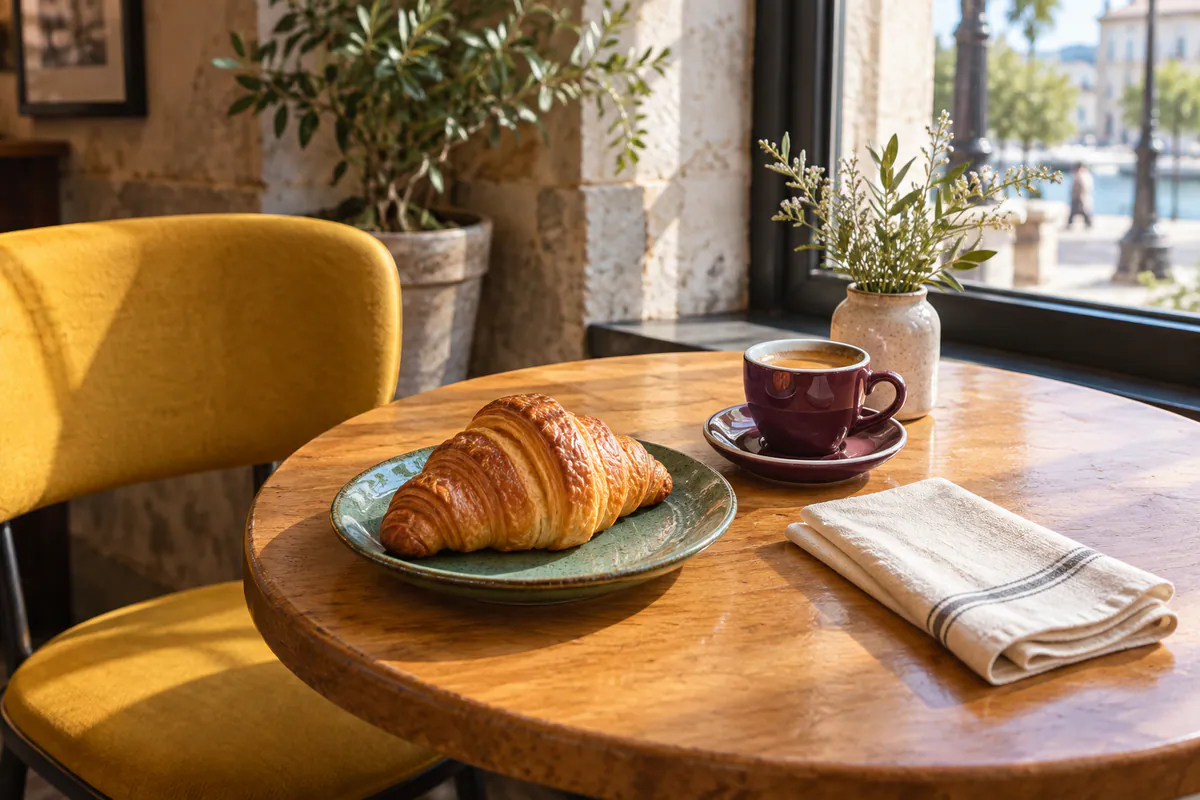
You would like lunch at a café, but nobody is available to join you. At the door, a simple meal starts to feel like a public announcement: everyone will notice that you are alone. You consider going home even though you are hungry and this is somewhere you wanted to try.
You do not have to turn lunch into a test of confidence. The aim can be smaller: choose somewhere suitable, order something you want, and give yourself permission to be one person having a meal. Feeling awkward does not make the plan a mistake.
Decide what you actually want from the visit
Ask yourself what would make this worthwhile today. Perhaps you need a convenient lunch between appointments. Perhaps you want to taste the soup, read a few pages, or sit somewhere outside your home. A concrete purpose gives you something to return to when you start imagining how you look to strangers.
Choose a setting that fits that purpose. A familiar counter-service café may feel simpler than an unfamiliar restaurant with a long tasting menu. Check opening hours and the menu if that removes a practical uncertainty. You are allowed to choose an easy first option rather than the most challenging one.
You can also decide that today is not the day. The point is to have a choice, not to force yourself through an experience so you can claim you were brave. If you do go, there is no requirement to stay longer than the meal you wanted.
Prepare one ordinary sentence
At the entrance, “A table for one, please” is enough. You do not need to explain that your friend is busy or pretend someone will arrive later. If the server asks whether anyone is joining you, “Just me today” answers the question.
If the ordering system is unclear, ask a practical question: “Do I order at the counter or at the table?” Not knowing a particular café's routine is a small information gap. Our guide to asking for clarification without putting yourself down offers more language for these moments.
A seat by a window, at a counter, or in a quieter corner may suit you. You can ask whether one is available without insisting on it. Let comfort guide the choice; you do not need to select the most visible table to prove anything.
Separate being noticed from being judged
Someone may glance toward your table. That is something you observed. “They think I have no friends” is an interpretation you cannot establish from the glance. You do not need to replace it with another certainty, such as “Nobody has noticed me at all.”
The NHS guidance on reframing unhelpful thoughts recommends looking at the evidence for a thought and considering a more balanced view. Here, a fair sentence might be: “I am sitting alone. I do not know what anyone else is thinking, and I came here for lunch.”
Use that sentence as a brief reminder, not a debate you must win before taking a bite. This is an everyday reflection suggestion, not a diagnosis or a treatment plan. You may still feel self-conscious while doing something that matters to you.
Give your attention somewhere to land
When the food arrives, notice something specific: its temperature, the texture of the bread, or whether you would order it again. Look at the view if you chose the window. These are parts of the visit that belong to you, regardless of how the room appears to other people.
Bring a book if you want to read. Use your phone if there is something you genuinely want to do. You do not have to perform a perfectly screen-free lunch, and you do not have to manufacture urgent messages to look occupied. Choose an activity because it serves the meal you wanted.
If you catch yourself repeatedly checking other tables for reactions, return to one immediate task: pour your water, choose the next bite, or read a paragraph. There is no score for how often you need to redirect your attention.
Finish without grading your personality
Ask for the bill when you are ready. Afterwards, review the practical experience: Was the food good? Was the room too loud? Did the counter seat suit you? Those answers can help you choose a future visit more usefully than deciding whether you looked sufficiently independent.
A mixed result is still information. You might have enjoyed the pastry and disliked the crowded room. Next time, you could choose an earlier hour or a different place. You are learning your preferences, not auditioning for a new identity.
You can use TherapyWithAI to rehearse an arrival sentence with fictional details. AI support cannot assess your circumstances fully or replace professional care. If fear of everyday social situations repeatedly limits your life, consider talking with a qualified professional. For an ordinary awkward lunch, the takeaway is simpler: you are allowed to eat somewhere you like without bringing an explanation for the empty chair.